
Lofty Goals.
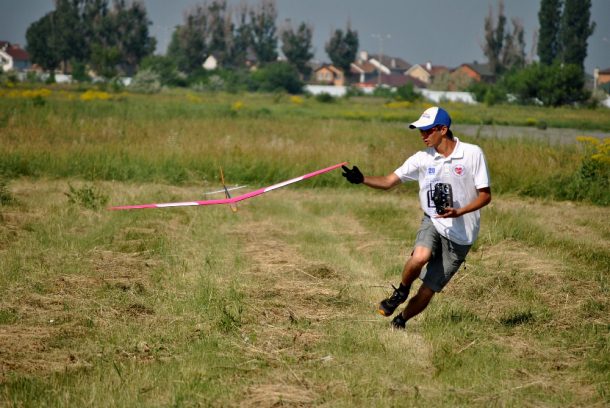
He’s been a model airplane enthusiast since the age of 10. He began delving into model rocketry last summer. Aleksandr Sinelitsiy is the newest sensation in the world of the recent flying season.
“How could I miss the chance to fly my Snipe at 240 meters high, instead of just 60?”
Aleksandr, when did you first get into model airplanes? What led you to this pastime? Was it your parents or friends, or was it simply a boyhood dream?
I got into model airplanes in the fifth grade. I was interested in them because, compared to most popular sports, how well a person does in model aviation is not dependent solely on the physical abilities of the athlete, or the amount he’s practiced; instead, a competitor’s performance is the result of how well he has built, set up, and prepared his aircraft for the event, as well as his knowledge of physics, mechanics, and meteorology. I think that the biggest thing that spurred me to take up model aviation was going to an air show held in commemoration of Operation Frantic. That was the first time I had seen either a real airplane or a radio-controlled model. I believe I was five or six at the time. At that moment, I decided that, one way or another, aviation was going to be a part of my life.
What are you especially proud of having accomplished in the field of model aviation?
Up to this point, I haven’t done anything particularly amazing. I’ve been the Ukrainian champion a few times, and I’ve been a member of the national team since 2011, competing in the F3K class. I’ve participated in both the European and World Championships … But competition is fierce in this class, and there are a lot of good pilots, so I think that anything noteworthy that I’m going to do still lies ahead.
How did you end up getting interested in model rocketry? How old were you when this happened?
I first came up with the idea of putting a rocket engine on my /glider about three years ago, but I didn’t know how to do it, or even where to get a normal rocket engine. But then, at the Vilga Cup, Aleksandr Golovin started talking about rocket-powered planes, and how he had attached a rocket engine to a Snipe. We had a chat and joked around a bit about how many rockets a person could put on it. A month later, he called me up and asked me to fly in the Ukrainian Championship in Dnepropetrovsk. I, of course, agreed. How could I miss the chance to fly my Snipe at 240 meters high, instead of just 60? But then, I got in a little car accident, and ended up with a concussion and a broken leg. I was sure that there was no way I was going to be able to fly in the S8 class, but then Aleksandr showed up in Poltava in his Honda and took me back to Dnepropetrovsk. That’s how it all started.
What have you managed to accomplish in the field of model rocketry so far? What competitions have you taken part in?
For now, the list isn’t very long. If you compare my performance in model rocketry with what I’ve accomplished in model aviation, then I’m a nobody in the field. I was able to “fly” at the Ukrainian Championship, the Dnepr Cup, the Yangel Cup, and the World Championship. I managed to win the Ukrainian Championship and the Yangel Cup, but at the World Championship I took second place.
What is your favorite class of model rocket and why?
I like the S8 most of all because it has an engine that takes it higher than 200 meters in just 10 seconds. I like how the plane glides, how I have full control over it, and how well it lands. Moreover, it’s probably one of the most athletically-intensive classes in model rocketry because performance doesn’t just depend on how the rocket is built, tuned, and launched; it also depends on the pilot himself throughout the entirety of the flight, on the quality and amount of practice he’s had, including what conditions he’s practiced in, on what kind of mood he’s in, and even on how he feels physically at the moment. For a pilot, a six-minute session with an S8 is an amazing adrenaline rush.
What is more important for you right now – your career in model rocketry, or your career in model aviation? Does either one get in the way of the other? Or perhaps doing both simultaneously gives you an advantage?
For me, both of them are important. In one, I’ve been moving toward my goal for a very long time, and I’ve already done quite a lot to ensure I achieve this goal. The other one I only recently tried my hand at, but I’ve already accomplished quite a bit there, and I know what I need to do to improve. I think that these two sports complement each other perfectly. The S8 has an amazingly high-altitude takeoff without room for error, and with the opportunity to fly at great heights and land on a dime. The F3K has the ability to descend from a height of 1.5 meters, land directly in your hand, and then launch again. The only downside to doing both of these things at the same time is that my practice and competition schedule is extremely full, but I’m sure I can get used to that.
Do people say that you’re a successful athlete, or even a sensation, in the world of model rockets, having taken silver at your very first major competition? What’s the secret to your success?
I’m successful because I came to model rocketry after spending quite a long time in model aviation, so I already had a lot of know how. I already knew what to do, how to train, how to ready my aircraft for competition; I knew what equipment was necessary, how to adjust my mood, and how to get myself in the correct headspace needed to achieve a respectable result. So, I used the experience I gained in model aviation to achieve success in model rocketry as well.
What are your plans for the upcoming season? What are you concentrating on?
In the upcoming season I’m planning on flying, flying, and flying some more. You’ll never achieve the results you want if you don’t practice. This is especially true now because this year our team showed the world that not only the Chinese know how to fly. Next season a lot of teams will be using new technology, and also rethinking their approach to flying. Therefore, in order to stay at the level we’re currently at, we need to train a lot and compete as much as possible, since competition is the best practice there is.
What is more respectable – winning in an individual event, or winning one as part of a team?
That really depends on the person, on whether he’s a team player or a lone wolf. I like being hoisted onto the pedestal myself, but it’s even better when your friends are there beside you!
How can a gifted athlete learn to be a team player?
It’s important for a talented athlete to understand that it doesn’t matter if he’s the most gifted player in the whole world – he’ll never be able to achieve by himself what he can as part of a team. After all, the triumph of one athlete is very often the result of the work of the team, the manager, the assistants, and the secretary. Together, all of these people do the things that the athlete simply cannot do by himself. As soon as you understand that, you’ll become a team player and you’ll shine brighter than ever!